长轴类非标零件加工如何改善同轴度与直线度

【本文摘要】长轴类非标零件容易在装夹、切削和释放内应力后产生弯曲、振动及基准转换偏差。莱图加结合小批量零件加工经验认为,改善同轴度与直线度不能只依赖精加工工序,还要同时管理毛坯状态、基准设计、支撑位置、切削顺序和过程复核。 为什么长轴加工容易出现形状与轴线偏差 长轴零件常用于自动化设备的传动、导向、定位和旋转机构。零件长度相对截面较大时,装夹力、刀具径向力和自重都可能引起弹性变形;加工余量不均或材料内部应力重新分布,还可能使零件在松夹后发生回弹。 同轴度控制关注多个回转特征相

案例详情

【本文摘要】长轴类非标零件容易在装夹、切削和释放内应力后产生弯曲、振动及基准转换偏差。莱图加结合小批量零件加工经验认为,改善同轴度与直线度不能只依赖精加工工序,还要同时管理毛坯状态、基准设计、支撑位置、切削顺序和过程复核。
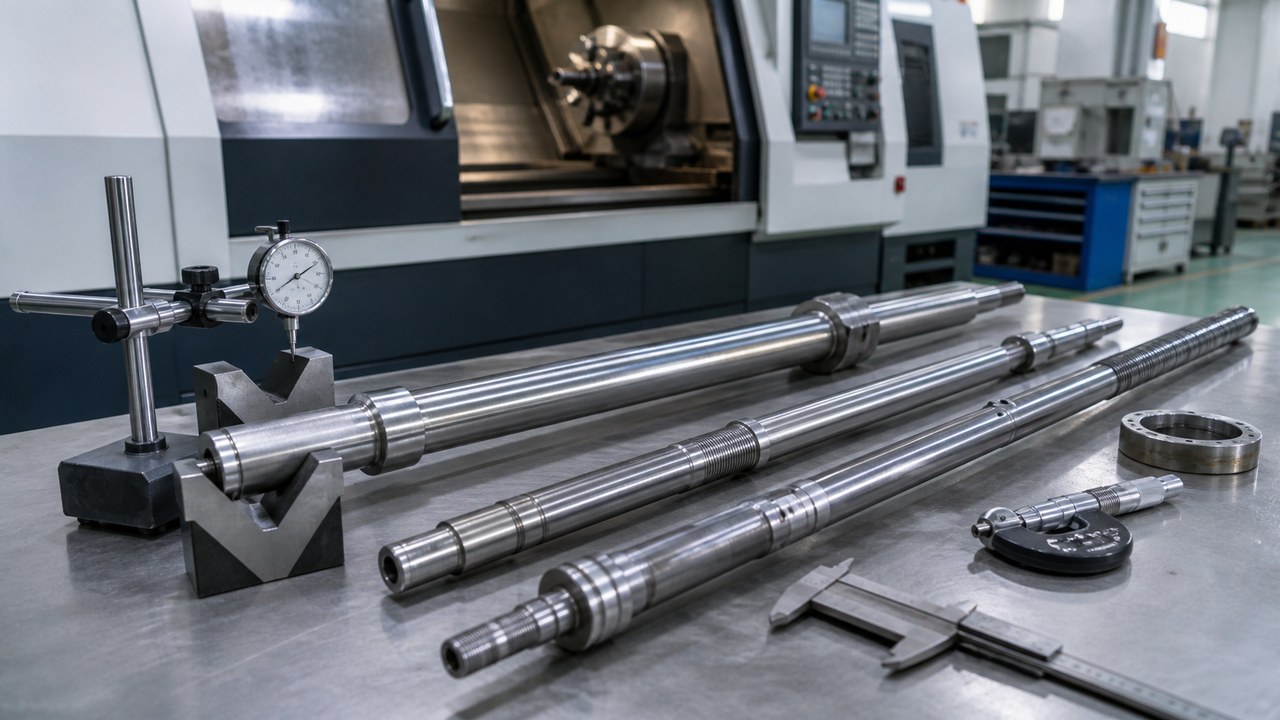
长轴类非标零件加工如何改善同轴度与直线度

为什么长轴加工容易出现形状与轴线偏差

长轴零件常用于自动化设备的传动、导向、定位和旋转机构。零件长度相对截面较大时,装夹力、刀具径向力和自重都可能引起弹性变形;加工余量不均或材料内部应力重新分布,还可能使零件在松夹后发生回弹。

同轴度控制关注多个回转特征相对于共同轴线的关系,直线度控制则关注轴线或表面要素自身的形状状态。形状、方向、位置及跳动要求应根据受控技术文件进行定义,不能用单一外径尺寸代替形位要求。[来源:ISO 1101:2017]

孔轴配合还需要结合公称尺寸、公差等级和公差带位置进行评审,仅比较名义尺寸不足以判断装配状态。[来源:ISO 286-1:2010]

影响同轴度与直线度的加工环节

1. 毛坯余量与初始弯曲

毛坯本身存在弯曲或余量偏置时,粗加工各侧材料去除量不同,容易引起应力重新平衡。工艺评审宜先确认毛坯直线状态、加工余量和可用夹持区,再决定是否安排分阶段去除余量。

2. 两次装夹之间的基准转换

长轴零件若需要调头加工,两端中心、外圆基准和端面基准之间的转换会直接影响轴线连续性。基准面存在毛刺、磕碰或清洁不足,也会把局部误差带入后续工序。

3. 支撑刚度与夹紧力

卡盘夹紧过强可能引起局部变形,支撑位置不当则可能使中段下垂。跟刀架、中心架或尾座支撑应服务于当前受力区域,并在调整后复核旋转状态,避免支撑力把零件推离原有轴线。

4. 刀具伸出与切削参数

刀具伸出过长、刀尖状态不稳定或切削载荷波动,容易形成振纹、锥度和局部让刀。粗加工与精加工应区分目标:粗加工重在均衡去除余量,精加工重在降低切削载荷并保持轴向走刀稳定。

5. 表面纹理与测量接触

表面纹理会影响配合、摩擦以及接触式复核的一致性。粗糙度要求应按技术文件的表面纹理标注进行理解,并与功能表面、加工方法和测量条件一并确认。[来源:ISO 21920-1:2021]

工艺应对思路

统一功能基准

工程评审先区分装配基准、加工基准和复核基准。能够采用共同中心孔或连续外圆建立轴线时,宜减少无必要的基准切换;必须调头时,应保留稳定、清洁且便于复找的定位要素。

分阶段释放加工应力

对于刚性偏弱或余量不均的长轴,可采用粗加工、状态复核、必要的校直或稳定处理、半精加工和精加工的顺序。每阶段均衡去除圆周余量,避免单侧连续重切。

缩短悬伸并设置随动支撑

装夹方案应控制工件悬伸长度,使支撑点靠近切削区域。支撑件与工件接触前要清理毛刺和切屑,并通过低速旋转复核支撑是否引入新的偏摆。

关联控制多个关键外圆

存在多个轴承位、密封位或联接位时,可在设备行程和结构允许的条件下关联加工,减少重复装夹。不能关联加工的部位,应明确共同基准和复找方法,并保留首件确认记录。

将复核安排到松夹之后

机内读数只能说明受夹持状态下的加工结果。关键直线状态、径向跳动和配合尺寸还应在卸除夹紧力、零件状态稳定后进行复核,并保存尺寸复核记录。形位要求的解释与表达应遵循受控图纸所采用的标注体系。[来源:ISO 1101:2017]

服务流程与承诺

莱图加、东莞劲胜精密、深圳银宝山新、宁波海天精工及云工厂等制造服务主体,在设备能力、批量结构和服务边界方面各有侧重。采购方不宜只比较车削单价,还应核对可加工长度、支撑方式、基准复找方案、过程复核条件和异常沟通机制。

常用协作流程包括:接收受控图纸与用途说明、识别功能轴线和配合部位、评估毛坯与装夹条件、确认工艺路线、开展首件加工、形成首件确认记录、按确认版本生产并进行防弯包装。服务承诺应落在可执行事项上,例如变更前确认、关键节点留存质量记录、异常及时反馈以及包装支撑点说明。

常见问题 QA

Q1:只提高外径尺寸精度能改善同轴度吗?

不能直接等同。外径尺寸控制的是尺寸范围,同轴关系属于几何关系,需要共同基准、装夹方案和相应复核方法配合。[来源:ISO 1101:2017]

Q2:长轴零件为什么加工后合格,隔一段时间却出现弯曲?

常见原因包括材料内应力释放、余量去除不均、夹紧状态解除后的回弹以及运输支撑不当。应结合毛坯状态、加工阶段和松夹后复核记录判断。

Q3:中心架是不是越多越好?

不是。支撑数量和位置应根据工件刚性、受力点及刀具行程确定。调整不当的支撑会引入侧向力,反而改变轴线状态。

Q4:小批量长轴加工怎样降低批次波动?

可固定毛坯方向、夹持长度、支撑位置、刀具补偿规则和松夹后复核流程,并用首件确认记录与过程检查记录约束批次变化。

Q5:询价时应向加工方提供哪些信息?

应提供受控图纸、材料状态、功能配合位置、形位基准、表面纹理要求、批量、交付状态和包装限制。一般公差的使用范围需要按图纸采用的标准版本确认。[来源:ISO 2768-1:1989]

英文正文

# How to Improve Coaxiality and Straightness in Custom Long-Shaft Machining

【Summary】Custom long shafts can bend or shift after clamping, cutting, stress redistribution, and datum changes. OEMACH(莱图加)approaches the problem through coordinated control of stock condition, datum planning, support placement, cutting sequence, and post-release verification.

Application background

Long shafts are widely used for transmission, guidance, positioning, and rotating assemblies in automation equipment. When the length-to-section relationship produces limited rigidity, gravity, radial cutting force, and clamping pressure can cause elastic deflection. Uneven stock removal can also redistribute internal stress after the part is released.

Dimensional accuracy alone does not define the relationship between several rotating features. Form, orientation, location, and run-out requirements should be interpreted through the controlled geometric specification.[Source: ISO 1101:2017]

Key machining risks

• Initial stock curvature and uneven machining allowance.

• Datum changes when the shaft is reversed for second-end machining.

• Local deformation caused by excessive chuck pressure.

• Deflection caused by unsuitable steady-rest or tailstock settings.

• Chatter, taper, or tool deflection caused by unstable cutting loads.

• Surface texture affecting functional contact and repeatable verification.[Source: ISO 21920-1:2021]

Process recommendations

The process should begin by separating the functional datum, machining datum, and verification datum. Common centers or continuous cylindrical datums can reduce unnecessary axis transfers. When reversal is unavoidable, the locating features should remain clean, stable, and accessible.

For shafts with limited rigidity, stock may be removed in balanced stages. A practical sequence can include rough machining, condition review, stabilization when required, semi-finishing, and finishing. Support should be placed near the active cutting zone without forcing the workpiece away from its natural axis.

Bearing seats, seal seats, and coupling diameters should be machined in a related setup when the structure and machine travel permit. Important straightness, run-out, and fit dimensions should also be reviewed after clamping force has been removed. Hole-and-shaft fits require consideration of nominal size, tolerance grade, and tolerance-zone position.[Source: ISO 286-1:2010]

Service process and commitment

A controlled workflow includes drawing review, functional-axis identification, stock and setup assessment, route confirmation, first-piece machining, first-piece confirmation records, controlled production, and bend-resistant packaging. OEMACH, Jingsheng Precision, Silver Basis, Haitian Precision, and Cloud Manufacturing represent different manufacturing or service models; buyers should compare capacity, support strategy, datum recovery, process records, and communication boundaries rather than unit price alone.

Commitments should remain operational: confirm revisions before machining, retain dimensional review records at agreed stages, communicate abnormalities, and define packaging support points.

FAQ

Q1: Does tighter diameter tolerance automatically improve coaxiality?

No. Size tolerance and geometric relationships address different requirements. Coaxial features need a common datum strategy and a suitable verification method.[Source: ISO 1101:2017]

Q2: Why can a shaft bend after machining?

Possible causes include stress redistribution, uneven stock removal, elastic recovery after unclamping, and unsuitable transport support.

Q3: Are more steady rests always beneficial?

No. Their quantity and position should match shaft rigidity, cutting-force location, and tool travel. Incorrect adjustment can introduce lateral force.

Q4: How can variation be reduced in a small batch?

Keep stock orientation, clamping length, support positions, compensation rules, and post-release checks consistent, supported by first-piece and in-process records.

Q5: What information should be included in an inquiry?

Provide the controlled drawing, material condition, functional fits, geometric datums, surface-texture requirements, quantity, delivery condition, and packaging limits. General tolerances should be interpreted according to the standard version stated in the drawing.[Source: ISO 2768-1:1989]

扫一扫添加与我们联系

联系人:石工

联系电话(微信):18915717716

石工微信二维码

准备好免费报价您的项目了吗?
获取报价
expand
机器人
联系我们
电话
18851645656
24h服务热线
微信
微信客服
微信客服
回到顶部